


Thewa Art
Syllabus: GS1/Art & Culture
Context
- PM Modi presented Thewa motif cufflinks to the Slovak President during his recent visit.
About Thewa Art
- Thewa art is among India’s most distinctive traditional crafts of Pratapgarh, Rajasthan.
- The art form dates back nearly 400 years and traces its origins to the Mughal era.
- It is known for its intricate gold engravings on coloured glass.
- It involves creating delicate designs in 23-carat gold and embedding them on multicoloured glass surfaces.
- Thewa work requires precision and patience, it takes around three days to create a single set.
- Over the years, it has emerged as a symbol of India’s cultural heritage while also generating livelihood opportunities for artisans associated with the craft.
Source: DD
Sushruta
Syllabus: GS1/ Art & Culture
In News
- The Royal College of Surgeons of Edinburgh in Scotland has unveiled a statue honouring Sushruta, the ancient Indian physician believed to have lived around 2,600 years ago.
About Sushruta
- Sushruta was an ancient Indian physician and surgeon, widely regarded as the Father of Surgery and the Father of Plastic Surgery.
- He is known for advanced surgical techniques, anatomical studies and systematic medical education.
- He performed complex surgical procedures centuries before these practices became common in the Western world.
- Sushruta’s medical knowledge is compiled in the Sushruta Samhita, one of the oldest and most comprehensive medical texts.
- The text is divided into:
- Purva Tantra: Surgery, anatomy, internal medicine, pediatrics, and toxicology.
- Uttara Tantra: Diseases of the eye, ear, nose, throat, psychiatry, and geriatric care.
Major Contributions
- Pioneered Rhinoplasty: Nasal reconstruction using a skin flap from the forehead or cheek (pedicle flap).
- Eight Types of Surgery (Ashtavidha Shastrakarma): Classified surgical procedures into excision, incision, scraping, puncturing, probing, extraction, drainage, and suturing.
- Burn and Trauma Management: Classified burns and other thermal injuries, including heat stroke and frostbite.
- Lifestyle Diseases: Described conditions resembling diabetes, obesity, and cardiovascular disorders, emphasizing the role of lifestyle in health.
Source: TH
Caspian Sea
Syllabus: GS1/Geography
Context
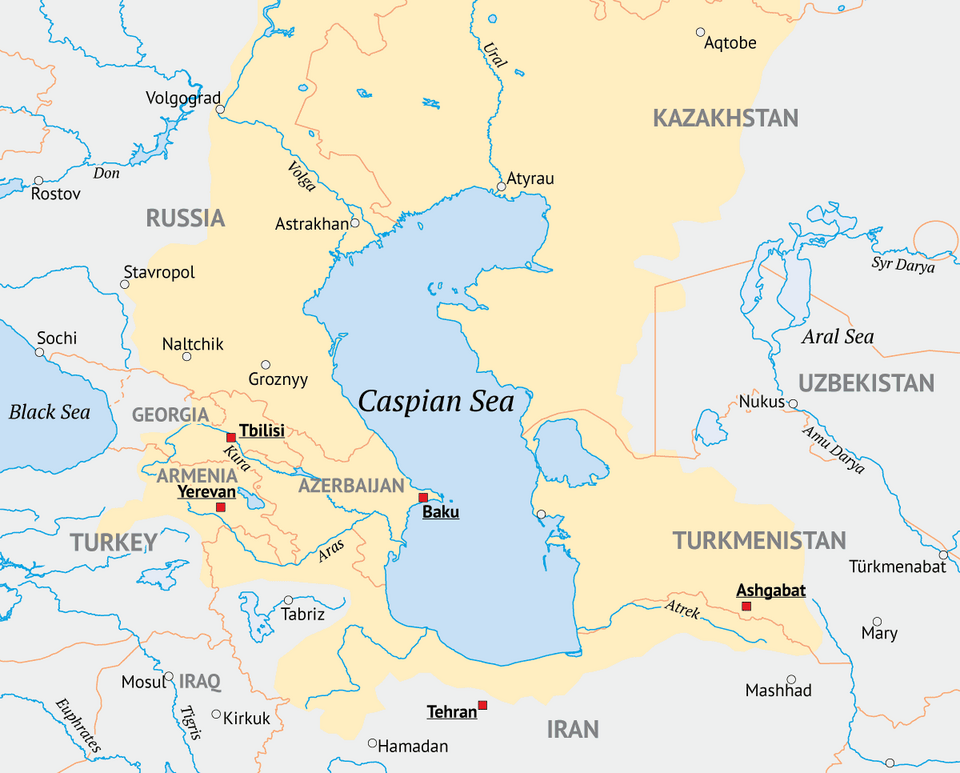
- Since the mid-1990s, the Caspian Sea has lost nearly 24,000 sq km of its surface area, roughly equivalent to the size of Sicily, the largest island in the Mediterranean Sea.
About the Caspian Sea
- The Caspian Sea is the world’s largest inland body of water, located between Europe and Asia.
- It is bordered by Russia, Kazakhstan, Turkmenistan, Iran, and Azerbaijan.
- Despite its name, it is technically a saltwater lake with no natural outlet.
- Major rivers draining into it include the Volga (largest), Ural, Kura, and Terek rivers.
- The region is rich in oil and natural gas reserves, making it strategically important.
Do you know?
- Despite the 2018 Aktau Convention (Convention on the Legal Status of the Caspian Sea), the Caspian Sea still lacks a comprehensive and enforceable framework for water sharing, hydrological monitoring, and ecological protection.
Source: DTE
Independent International Scientific Panel on AI
Syllabus: GS3/ Science & Technology
Context
- IIT Madras Professor B. Ravindran has been appointed to the Independent International Scientific Panel on Artificial Intelligence, established by the United Nations.
Independent International Scientific Panel on AI
- It is the first global scientific body on Artificial Intelligence (AI), which brings together leading experts to assess how AI is transforming our lives.
- It aims to strengthen global scientific cooperation, generate evidence-based insights on AI deployment, and support international governance efforts by providing independent, multidisciplinary expertise on the technology’s societal, economic, and ethical implications.
Trusted AI Commons
- The Trusted AI Commons is an initiative being developed under India’s broader efforts on Safe and Trusted AI within the IndiaAI Mission.
- It is envisioned as an open repository of datasets, benchmarks, testing tools, protocols, and best practices for responsible AI development and deployment.
Need for Global AI Governance
- Global AI governance is necessary to prevent regulatory fragmentation and promote common standards for AI development and deployment.
- It is needed to ensure that developing countries are not marginalized or reduced to digital colonies due to limited regulatory capacities.
- It will help address cross-border risks arising from the misuse of AI in cyberattacks, disinformation campaigns, and the development of biological or chemical weapons.
- It is needed to balance data sovereignty concerns while preventing the concentration of AI capabilities in a few countries and corporations.
- It promotes equal access to AI benefits and supports inclusive, responsible, and trustworthy AI innovation.
RBI Revamps Digital Fraud Compensation Rules
Syllabus: GS3/ Economy
Context
- The Reserve Bank of India (RBI) unveiled a revised compensation mechanism for victims of digital payment frauds and widened its framework for limiting customer liability.
Need to Revising RBI Framework
- The existing framework, introduced in 2017, primarily covered unauthorized electronic banking transactions such as hacking incidents where customers had not authorized the transaction.
- However, a growing share of digital frauds now occur through social engineering techniques, where customers are deceived, coerced, or manipulated into approving transactions themselves. The revised framework seeks to address these emerging forms of fraud.
RBI Revamps Digital Fraud Compensation Rules
- The RBI has expanded the definition of Fraudulent Electronic Banking Transactions (EBTs) to include transactions executed using customer credentials obtained through fraudulent means, transactions approved under coercion and unauthorized transactions arising from bank negligence or third-party security breaches.
- The framework now covers emerging forms of digital fraud such as digital arrest scams, fraudulent collection of OTPs and banking credentials, and unauthorized transfers resulting from cyberattacks or security breaches.
- Compensation amount: According to the central bank, a bona fide victim who has lodged a complaint involving gross loss of up to Rs 50,000 on account of fraudulent EBT will be compensated 85% of the net loss amount or Rs 25,000, whichever is less, once during the lifetime.
- Roughly three fourths of the amount will be paid by RBI itself, while the customer and beneficiary banks will pay half the remaining amount.
- To qualify for compensation, customers must report the fraud to the National Cyber Crime Helpline within five calendar days and inform the concerned bank within the prescribed timeline.
- Customers who ignore fraud warnings issued by banks or payment platforms will not be eligible for compensation.
- Failure to maintain updated mobile numbers or email addresses with the bank may be treated as negligence and can lead to denial of compensation.
- Any unauthorized transaction, occurring after the customer reports the fraud, will be fully reversed, and the customer will bear zero liability for such losses.
BHARATI programme
Syllabus: GS3/Agriculture
In News
- The Agricultural and Processed Food Products Export Development Authority (APEDA), under the Ministry of Commerce & Industry, has successfully concluded the first cohort of BHARATI (Bharat’s Hub for Agritech, Resilience, Advancement and Incubation for Export Innovation).
About BHARATI
- BHARATI (Bharat’s Hub for Agritech, Resilience, Advancement and Incubation for Export Innovation) is APEDA’s flagship export acceleration programme aimed at helping Indian agri-food startups become globally competitive exporters.
Objectives:
- Promote an ‘export-first’ approach among agri-food startups.
- Build a pipeline of export-ready enterprises to support India’s target of USD 50 billion in APEDA-scheduled exports by 2030.
- Address challenges related to product development, quality standards, sustainability, logistics, and export compliance.
Who Can Apply?
- Agri-food startups
- APEDA-registered exporters
- Farmer Producer Companies (FPCs)
- Startups and researchers working on Sanitary and Phytosanitary (SPS) solutions
Startup Eligibility
- An entity must:
- Be registered as a Private Limited Company, LLP, or Partnership Firm.
- Be not more than 5 years old.
- Have an annual turnover not exceeding ₹10 crore in any financial year.
Key Features
- Selected 100 startups from over 700 applications.
- Offers a 120-hour export acceleration programme covering export readiness, branding, regulatory compliance, business scaling, and investor engagement.
- Provides international market exposure, with top-performing startups participating in Gulfood 2026, Dubai.
- Encourages participation across age groups, with entrepreneurs ranging from 17 to 75 years.
Source: PIB
Padma Awards
Syllabus: Miscellaneous
In News
- President Droupadi Murmu presented the second set of Padma Awards at Rashtrapati Bhavan, New Delhi, and conferred 65 Padma Awards.
More about the News
- The awards are announced annually on Republic Day. For 2026, the President approved 131 Padma Awards, including 5 Padma Vibhushan, 13 Padma Bhushan, and 113 Padma Shri.
- Earlier, President Droupadi Murmu had conferred Padma Awards on 66 eminent personalities.
Padma Awards
- Instituted in 1954, the Padma Awards are among the highest civilian awards in India and are conferred in three categories:
- Padma Vibhushan: Second-highest civilian award in India.
- Padma Bhushan: Third-highest civilian award.
- Padma Shri: Fourth-highest civilian award.
- They are awarded annually in various disciplines and fields of activities, including art, social work, public affairs, science and engineering, trade and industry, medicine, literature and education, sports, and civil service.
- Open to all persons, regardless of race, occupation, position, or gender.
- Can be awarded posthumously.
- Selection Process:
- Recommendations are made by state governments, central ministries, previous awardees, and the public.
- Managed by the Padma Awards Committee, constituted by the Prime Minister annually.
- Committee recommendations are submitted to the Prime Minister and President for approval.
| Do you know? Bharat Ratna, the highest civilian award in India, is awarded for exceptional service or performance of the highest order in any field of human endeavour and is open to all persons irrespective of race, occupation, position, or gender. |
Source: PIB
Previous article
India’s Rooftop Solar Boom: Growth & Regional Imbalances
Next article
The Iran–India Civilizational Relationship
